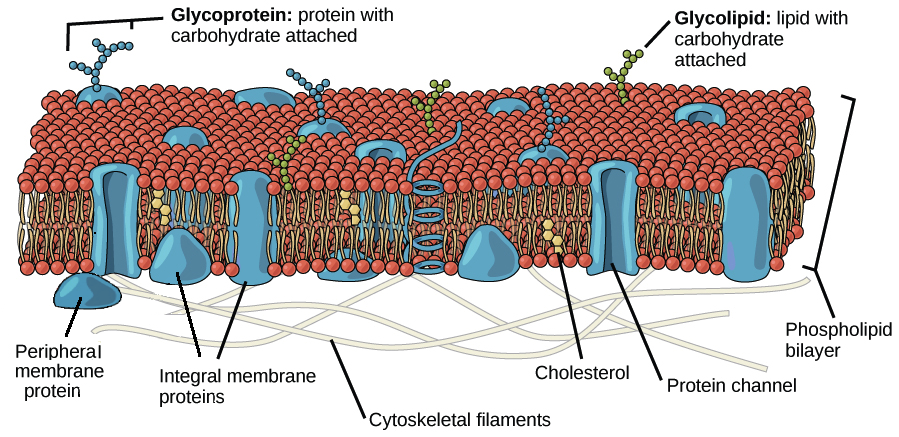
The plasma membrane is a dynamic fluid mosaic of phospholipids, cholesterol, and proteins that functions as a selective barrier and a hub for cellular communication.
Phospholipids are amphipathic molecules forming a bilayer, with hydrophilic heads and hydrophobic tails whose saturation level influences membrane fluidity.
Membrane proteins include channels, carriers, pumps, and receptors, enabling passive/active transport and signal transduction. Key signaling pathways involve phospholipases: PLA₂ releases arachidonic acid from membrane phospholipids, which is then converted via COX, LOX, or CYP450 pathways into potent inflammatory mediators such as prostaglandins, leukotrienes, and EETs. PLC hydrolyzes PIP₂ to generate second messengers DAG (activates PKC) and IP₃ (triggers Ca²⁺ release). PI3K produces PIP₃, which recruits Akt to promote cell survival and growth.
GPCRs activate G proteins (Gs, Gi, Gq, G12/13), regulating cAMP/PKA, PLC, or Rho pathways, while receptor tyrosine kinases (RTKs) and cytokine receptors initiate Ras/MAPK, PI3K/Akt, or JAK-STAT cascades. Receptors can be desensitized by β-arrestins after GRK phosphorylation. Together, these membrane-associated systems regulate inflammation, immunity, proliferation, metabolism, and homeostasis, with therapeutic targets including COX inhibitors (NSAIDs, coxibs), 5-LOX inhibitors (zileuton), and JAK inhibitors.
- Teacher: douaoui sanaa
- Teacher: abes rachida
- Enseignant: abes rachida
- Enseignant: meziane warda